

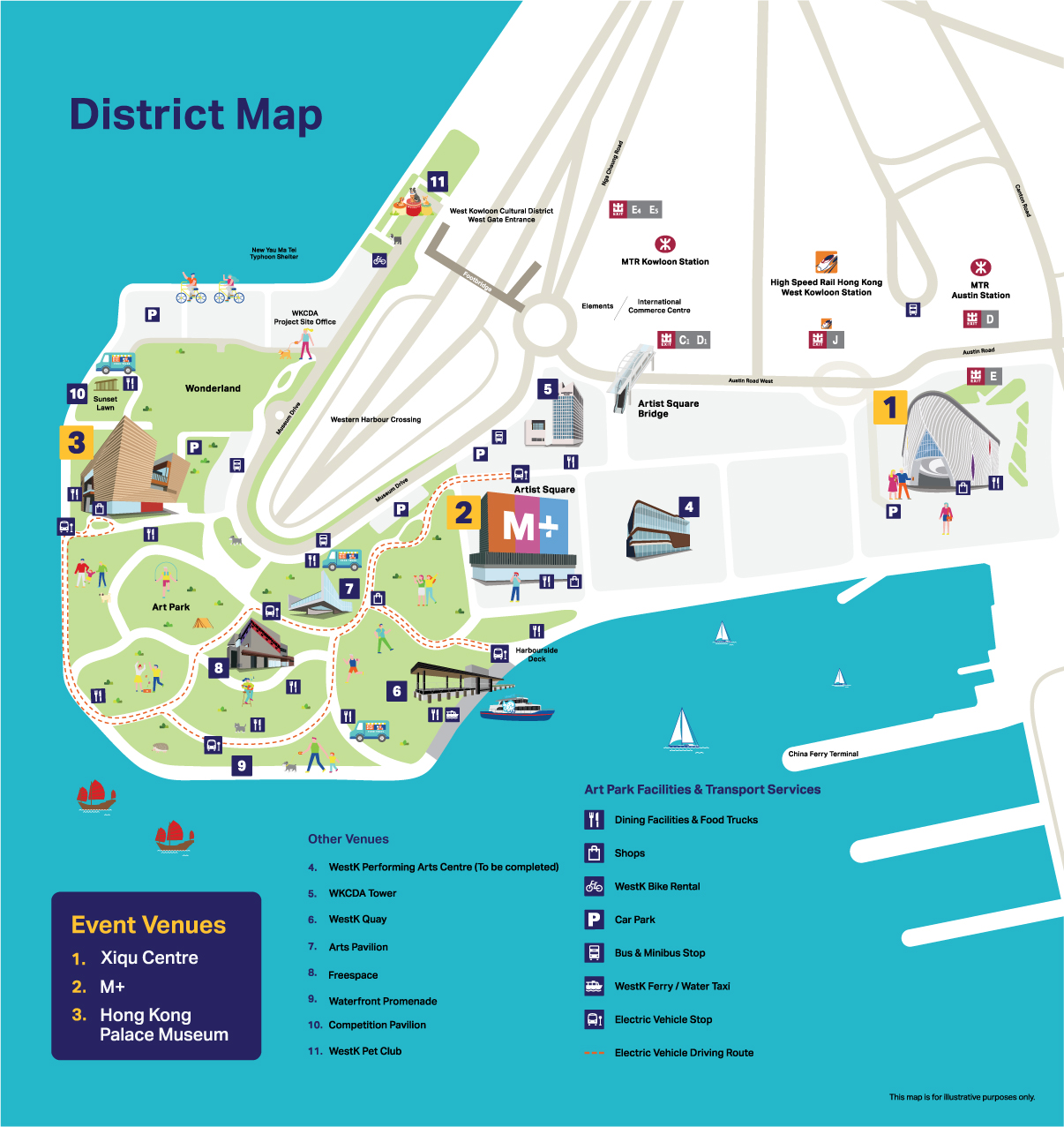
The Summit will take place at venues across WestK.
We will be hosting more than 1,000 delegates at the Xiqu Centre for the Opening and Plenary Session of the Summit on the morning of 23 March 2026. Panel Discussion Sessions will be conducted at M+ and the Hong Kong Palace Museum in the afternoon of the same day.
Livestreaming will be available for all sessions of the Summit.
About Hong Kong Palace Museum

The Hong Kong Palace Museum (HKPM) aspires to become a leading cultural institution committed to the study and appreciation of Chinese art and culture. Opened in July 2022, HKPM is a collaborative project between the West Kowloon Cultural District Authority (WKCDA) and the Palace Museum in Beijing. Featuring more than 900 precious treasures from the Palace Museum, including 166 grade-one objects, the opening exhibitions series constitute the Palace Museum’s largest loan to an institution outside Mainland China since its establishment in 1925
At its heart, the HKPM is a cultural resource that belongs to the community of Hong Kong. It is a dynamic platform that inspires community engagement, fosters cross-cultural dialogues and works to promote creativity and interdisciplinary collaboration. Through research, exhibitions and publications, as well as educational, cultural and professional exchange programmes, the Museum builds international partnerships and helps position Hong Kong as a hub for art and cultural exchanges between China and the rest of the world.
A fresh and contemporary interpretation of traditional architectural aesthetics, the HKPM building houses nine galleries covering a total of 7,800 square metres, a 400-seat auditorium, a museum shop and several restaurants. Designed by Hong Kong-based Rocco Design Architects Associates, the building draws inspiration from both Chinese art and architecture and Hong Kong’s urban environment. Three atriums connect the different floors of the HKPM vertically, referencing the horizontal spatial configuration of the Forbidden City along its central axis and embracing a spirit of bringing Chinese heritage to modern audiences. The HKPM building has won the HKIA Medal of the Year in HKIA Annual Awards 2022/23 from the Hong Kong Institute of Architects.
About M+

M+ is the first global museum of contemporary visual culture in Asia. Opened in November 2021, it features permanent collections rooted in Asia but defined, developed and examined from a global perspective. With a total of 33 galleries spanning 17,000 square metres, M+ is dedicated to collecting, exhibiting and interpreting visual art, design and architecture, moving images and Hong Kong visual culture of the 20th and 21st centuries. The museum also includes three cinema houses, two museum shops and a number of restaurants, as well as a member-exclusive M+ lounge. M+ also has a standalone Conservation and Storage Facility to house its 8,000+ collections and conservation laboratories.
Designed by a global team of world-renowned architecture firms, Herzog & de Meuron in partnership with TFP Farrells and Arup, M+ is both monumental in its architectural form and radically open in its position in the urban landscape. Located on the Victoria Harbourfront, the M+ Facade is embedded with LEDs for screening moving image works. The Facade’s custom-designed cladding draws inspiration from traditional Chinese roofs. The museum building is in a structure not simply anchored in its surroundings, but also formed by them.
About Xiqu Centre

The Xiqu Centre opened its doors to the public in January 2019 as a world-class performing arts venue in WestK dedicated to the preservation, promotion and development of Chinese traditional theatre, in particular Cantonese opera. Presenting traditional xiqu performances, the Xiqu Centre strives to advance the legacies and traditions of this unique artform, while simultaneously encouraging artists to create new pieces or improve on existing works. It seeks to expand the audience base and encourage a new generation of artists for xiqu, sharing Hong Kong’s world intangible cultural heritage with an international audience.
The Xiqu Centre consists of two theatres, a seminar hall and eight rehearsal studios. The 1,075-seat Grand Theatre is a world-class venue tailor-made for professional xiqu performances, fitted with an orchestra pit and state-of-the-art lighting and sound equipment. The Tea House Theatre was designed to recreate the intimate atmosphere and experience of a traditional tea house, offering Chinese tea and dim sum during performances. It is also suitable for small-scale performances of regional xiqu genres or traditional music.
The eight-storey Xiqu Centre was designed by Bing Thom Architects (now Revery Architecture) and Ronald Lu & Partners. The striking architectural design embodies the essence of the xiqu art form, with the concept of “flow” or “qi” interpreted in the fluid movements of the building and the use of curved planes, arched openings and circular paths. The Atrium has a large podium and is light and spacious, with doorless entrances that open to the outdoors, making it an attractive destination any day of the week, even at times when no performances are taking place.